I've got a few major updates for all of you.
First of all, we've made a plan. I'm still probably going to be discharged on September 2nd, but I won't be going home right away. Going home might not happen for several months yet. Rather, my social worker is looking for a place for me in a long-term care facility as a short-term housing solution. Yes, I'm going to be housed with elderly patients for a while, but that's just because the facility will be wheelchair-accessible, have any and all equipment I might need to attend to my daily needs, and there will be trained staff on hand should I need them. I just need somewhere safe to stay while my body heals, and this is the best solution for now. We'll be continuing therapy while I'm in the long-term care facility, and I may become an inpatient in the rehabilitation hospital again if my rate of progress really takes off.
Second, I've begun trying out a power chair, and I'm loving it! I came in with the misconception that power chairs are just for people in really bad shape, like quadriplegics. Thankfully, my healthcare team smartened me up about that one by pointing out that using a power chair at least part of the time will grant me more independence: I can go to more distant places by myself, I can get everywhere much faster than in a manual chair, I can conquer more obstacles because the chair does all the work, and it will make snow a much smaller issue in the winter if I still need chair by then. I'll still have a manual chair as a backup in case the power chair needs maintenance or charging, plus I can scoot around in small spaces just fine with a manual chair without tiring myself right out.
Finally, my CK levels are down again! The last test came back as 3140 -- down from 5400! I'm hoping that this means that the rituximab is finally kicking in, rather than last week's test result just being a lab error or something of the like. You see, rituximab is a funny drug. It works miracles for some people, and doesn't work at all for others; when it does work, it can take two weeks to several months to do its job. If it does work for me, then it should bring my CK levels down to normal. That will mean that there will no longer be any ongoing damage done to my muscles. I'll start bouncing back much more quickly because my rate of healing won't have to outpace any sort of damage.
This has been a quick, but important update. Hopefully I'll have access to the computer again tomorrow or the day after so I can get to one of the essays I have in mind.
Wednesday, 30 July 2014

Wednesday, 23 July 2014
Taper
This, my friends, is a tapir:
 Why is there a tapir? Because the name happens to look like "taper," and this lil' guy's expression just happens to perfectly capture how I'm feeling today.
We've started tapering my prednisone dosage from 100 mg a day to 90. Considering that weaning off prednisone is known to cause serious mood swings and irritability, I'm guessing my mood today has been caused, at least in part, from my body saying "yes" to drugs. But of course, that's not the only reason I wish I could get a do-over on today. Oh no.
My damn CK level spiked. Again. It'd been hovering around 3000-3500 for weeks, but the blood test on Tuesday revealed that it shot back up to 5400. It could be just a fluctuation, it could be that the medication isn't working as well, it could be that my inflammation is accelerating along with damage to my muscles, or maybe I've been misdiagnosed. Not every auto-immune disease has been named yet, after all, and polymyositis is already an officially labelled "rare disease." All we can do is just sit and wait to see if the rituximab finally kicks in, or try yet another prescription to see if that does the trick. And you know what's going to be going through my mind the entire time? "What if I'm one of the unlucky few who still dies from this?" Again, that's possible: myositis diseases can cripple all of your muscles, including the ones you need to breathe and keep your heart beating.
On a rational level, I know the odds of it getting that bad are virtually nil by now, but since when has fear been a rational beast? Oh no, that son of a bitch has latched onto my gut and won't let me shake the thought that maybe we can't, or won't, get this disease really and truly under control in time to save me from it.
To top that off, I had a wheelchair skills assessment today. Being put through my paces like that just made me feel weak and helpless. My arms are still weak enough that you can seriously trap me in a room with a two-inch high barrier. I know I'm going to get stronger, but it's incredibly frustrating to have what you can't do pointed out to you.
We've also made the decision to move me to a long term care facility. It's only temporary, thankfully, because I just need somewhere safe and accessible to stay until my disease settles down enough for me to make some major progress. However, the rules here say that once that decision has been made, then therapy has to stop. We've been assured that they'll at least do maintenance therapy with me (ie: stretching me every day so I don't lose what range of motion I've gotten back), but that's all. My doctor is going to advocate for me to continue receiving therapy while I'm waiting for placement, though, because I actually am a special case. I'm going to get better; we're just waiting for my body to get through this tough phase. What worries me is that the wheelchair trials may be stopped, too, and I don't own or rent a chair. Insurance or ADL will help us with that, but I'm a bit worried that I might wind up stuck between chairs.
Bedridden. Again. Getting weaker and weaker with every day from lack of exercise, and all because one place couldn't lend me some wheels while we wait for a set to be made/become available, or simply because paperwork takes a long time to process.
Argh. Okay. Okay. I gotta get my mind off this. Gotta try not to dwell on the negative for the entire day. Okay. How about some positives instead?
We've been practicing sliding board transitions for a couple of weeks, and today's was definitely a bit easier. This means that I'm that much closer to not needing a mechanical lift to get in and out of bed, and that much closer to not needing help to get out of bed/my chair. I can also lean forward enough to rest my elbows on the table, so eating just became a lot tidier for me. If I drop something now, it goes on the table rather than my shirt.
My trial power chair also came in today, and I'm not bad at driving it. I'm still not allowed to take it around on my own just yet, but that should happen soon. Once I'm allowed to take it outside on my own, then I'll be able to just take off on short trips outside when I'm bored. I never thought I'd look forward to using a power chair, but after trying (and failing) to get up a ramp? Oh yeah. Give me a motor, baby.

We've started tapering my prednisone dosage from 100 mg a day to 90. Considering that weaning off prednisone is known to cause serious mood swings and irritability, I'm guessing my mood today has been caused, at least in part, from my body saying "yes" to drugs. But of course, that's not the only reason I wish I could get a do-over on today. Oh no.
My damn CK level spiked. Again. It'd been hovering around 3000-3500 for weeks, but the blood test on Tuesday revealed that it shot back up to 5400. It could be just a fluctuation, it could be that the medication isn't working as well, it could be that my inflammation is accelerating along with damage to my muscles, or maybe I've been misdiagnosed. Not every auto-immune disease has been named yet, after all, and polymyositis is already an officially labelled "rare disease." All we can do is just sit and wait to see if the rituximab finally kicks in, or try yet another prescription to see if that does the trick. And you know what's going to be going through my mind the entire time? "What if I'm one of the unlucky few who still dies from this?" Again, that's possible: myositis diseases can cripple all of your muscles, including the ones you need to breathe and keep your heart beating.
On a rational level, I know the odds of it getting that bad are virtually nil by now, but since when has fear been a rational beast? Oh no, that son of a bitch has latched onto my gut and won't let me shake the thought that maybe we can't, or won't, get this disease really and truly under control in time to save me from it.
To top that off, I had a wheelchair skills assessment today. Being put through my paces like that just made me feel weak and helpless. My arms are still weak enough that you can seriously trap me in a room with a two-inch high barrier. I know I'm going to get stronger, but it's incredibly frustrating to have what you can't do pointed out to you.
We've also made the decision to move me to a long term care facility. It's only temporary, thankfully, because I just need somewhere safe and accessible to stay until my disease settles down enough for me to make some major progress. However, the rules here say that once that decision has been made, then therapy has to stop. We've been assured that they'll at least do maintenance therapy with me (ie: stretching me every day so I don't lose what range of motion I've gotten back), but that's all. My doctor is going to advocate for me to continue receiving therapy while I'm waiting for placement, though, because I actually am a special case. I'm going to get better; we're just waiting for my body to get through this tough phase. What worries me is that the wheelchair trials may be stopped, too, and I don't own or rent a chair. Insurance or ADL will help us with that, but I'm a bit worried that I might wind up stuck between chairs.
Bedridden. Again. Getting weaker and weaker with every day from lack of exercise, and all because one place couldn't lend me some wheels while we wait for a set to be made/become available, or simply because paperwork takes a long time to process.
Argh. Okay. Okay. I gotta get my mind off this. Gotta try not to dwell on the negative for the entire day. Okay. How about some positives instead?
We've been practicing sliding board transitions for a couple of weeks, and today's was definitely a bit easier. This means that I'm that much closer to not needing a mechanical lift to get in and out of bed, and that much closer to not needing help to get out of bed/my chair. I can also lean forward enough to rest my elbows on the table, so eating just became a lot tidier for me. If I drop something now, it goes on the table rather than my shirt.
My trial power chair also came in today, and I'm not bad at driving it. I'm still not allowed to take it around on my own just yet, but that should happen soon. Once I'm allowed to take it outside on my own, then I'll be able to just take off on short trips outside when I'm bored. I never thought I'd look forward to using a power chair, but after trying (and failing) to get up a ramp? Oh yeah. Give me a motor, baby.
Saturday, 19 July 2014
Small steps
Well, this blog's title just became quite literal.
Today, being a Saturday and thus part of the weekend, I got a day off from my therapy sessions. The idea is that patients need a break from the often intense workouts we get during the week. Did I rest? Heck, no! I see days off as chances to just experiment and see what I can do. Now, small things like bending at the waist on my own and lifting my legs against gravity have been major obstacles for me since I've been sick. This is because polymiositis affects the proximal muscles first, and thus affects them the most extensively. I'd also spent the better part of a month lying in a bed, which will make anyone at least a bit stiff in the back.
Well, because of that, my back had been so stiff for a while that my abdominal muscles were just too weak to bend me, and even other people struggled to help me do things like sit up and lean forward. Well, you know what? Thanks to being stretched every day and my body healing up, I can now lean forward in my wheelchair far enough to do things like unlock my foot rests and get my hands about halfway down my calves. This means that I'm that much closer to regaining the ability to do things like get my own shoes on and off!
As an added bonus, my legs have finally become strong enough for me to take very real, but small, steps while in the chair. I've been able to kick my legs out just fine for several weeks, but this is lifting them against gravity, stretching them to put a foot out, then pulling myself and my chair forward. This is how I'm starting to walk again. This is how I'm going to take my life back and beat this disease. Even if it looks a little funny to watch someone taking teeny tiny steps while in a wheelchair.
Today, being a Saturday and thus part of the weekend, I got a day off from my therapy sessions. The idea is that patients need a break from the often intense workouts we get during the week. Did I rest? Heck, no! I see days off as chances to just experiment and see what I can do. Now, small things like bending at the waist on my own and lifting my legs against gravity have been major obstacles for me since I've been sick. This is because polymiositis affects the proximal muscles first, and thus affects them the most extensively. I'd also spent the better part of a month lying in a bed, which will make anyone at least a bit stiff in the back.
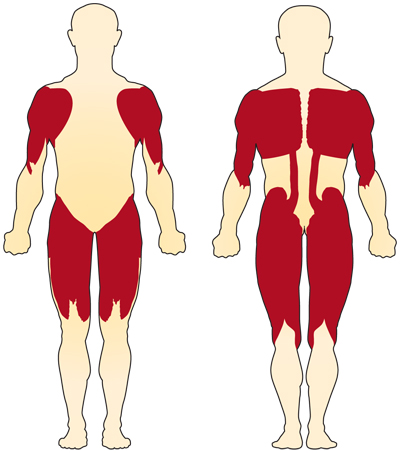 |
| Proximal Muscles (image shamelessly borrowed from mda.org |
Well, because of that, my back had been so stiff for a while that my abdominal muscles were just too weak to bend me, and even other people struggled to help me do things like sit up and lean forward. Well, you know what? Thanks to being stretched every day and my body healing up, I can now lean forward in my wheelchair far enough to do things like unlock my foot rests and get my hands about halfway down my calves. This means that I'm that much closer to regaining the ability to do things like get my own shoes on and off!
As an added bonus, my legs have finally become strong enough for me to take very real, but small, steps while in the chair. I've been able to kick my legs out just fine for several weeks, but this is lifting them against gravity, stretching them to put a foot out, then pulling myself and my chair forward. This is how I'm starting to walk again. This is how I'm going to take my life back and beat this disease. Even if it looks a little funny to watch someone taking teeny tiny steps while in a wheelchair.
Wednesday, 16 July 2014
Wheelchairs and Energy Levels
This was me yesterday:

Y'see, myositis disorders tend to restrict how much energy you have. My attitude of "go hard or go home" when it comes to physiotherapy sometimes gets me into trouble because of this. If I push myself too hard one day, I'm going to feel tired and weak for the entire next day, and possibly even the one after that. Getting up? Didn't want to do that. Exercise? Didn't want to do that, but I still did for my own good. Assembling my thoughts into coherent sentences for the purpose of blogging? Forget about it. I do try to limit myself a bit so that I have enough energy to do things like go for a stroll or visit after my therapy sessions are done, but sometimes I misjudge. When that happens, I burn right out and can't summon the energy to do much of anything.
Mind you, I'm sure staying up until 2 a.m. Monday night reading didn't help.
Oh, and it was all one book. Just one very long and very fascinating reading session, and holy crap you guys need to read this book.

This is Susannah Cahalan's memoir about her experience with anti-NMDA receptor encephalitis, a very rare auto-immune disorder that attacks the brain. While I can personally relate to some of what she went through, her account is jaw-dropping. The poor woman lost her mind for a month due to the disease, and struggled to regain not only her health but her very identity as the treatment began to take effect. The way her family stuck by her, and stuck up for her, made me want very much to give my own a hug.
Seriously. Everyone who's made it out to see me? You guys have made my stay in the hospital much more pleasant than it would be otherwise. Without you, every day would just slog into the next, with no meaningful division between them other than sleep. I'd probably be a lot more listless without you, and nowhere near as far along the road to recovery as I am now. Thank you.
In other news, I finally found a dud in my wheelchair trials today. This supposedly lighter chair was supposed to be easier to propel and maneuver, but the darn thing was just as heavy, didn't want to turn, and the wheels were so far back I couldn't reach them properly. Thankfully, my Occupational Therapist found my old chair and swapped me back into it. I still hate how stiff the brakes are on here, but at least I can move around again. Ah well...that's what these trials are for, right? It's just like buying a car: you have to try a bunch to see what works and what doesn't for you. Except that here, the car won't even start if it's wrong for you.

Y'see, myositis disorders tend to restrict how much energy you have. My attitude of "go hard or go home" when it comes to physiotherapy sometimes gets me into trouble because of this. If I push myself too hard one day, I'm going to feel tired and weak for the entire next day, and possibly even the one after that. Getting up? Didn't want to do that. Exercise? Didn't want to do that, but I still did for my own good. Assembling my thoughts into coherent sentences for the purpose of blogging? Forget about it. I do try to limit myself a bit so that I have enough energy to do things like go for a stroll or visit after my therapy sessions are done, but sometimes I misjudge. When that happens, I burn right out and can't summon the energy to do much of anything.
Mind you, I'm sure staying up until 2 a.m. Monday night reading didn't help.
Oh, and it was all one book. Just one very long and very fascinating reading session, and holy crap you guys need to read this book.

This is Susannah Cahalan's memoir about her experience with anti-NMDA receptor encephalitis, a very rare auto-immune disorder that attacks the brain. While I can personally relate to some of what she went through, her account is jaw-dropping. The poor woman lost her mind for a month due to the disease, and struggled to regain not only her health but her very identity as the treatment began to take effect. The way her family stuck by her, and stuck up for her, made me want very much to give my own a hug.
Seriously. Everyone who's made it out to see me? You guys have made my stay in the hospital much more pleasant than it would be otherwise. Without you, every day would just slog into the next, with no meaningful division between them other than sleep. I'd probably be a lot more listless without you, and nowhere near as far along the road to recovery as I am now. Thank you.
In other news, I finally found a dud in my wheelchair trials today. This supposedly lighter chair was supposed to be easier to propel and maneuver, but the darn thing was just as heavy, didn't want to turn, and the wheels were so far back I couldn't reach them properly. Thankfully, my Occupational Therapist found my old chair and swapped me back into it. I still hate how stiff the brakes are on here, but at least I can move around again. Ah well...that's what these trials are for, right? It's just like buying a car: you have to try a bunch to see what works and what doesn't for you. Except that here, the car won't even start if it's wrong for you.
Monday, 14 July 2014
You have what now?
Alright. Let's do this. As my friends and family know, I've been in one hospital or another since May. I know a lot of you have a lot of questions about what I've got and how I'm doing, so I'm starting this blog to help keep everyone in the loop about my progress. Since it's my blog, I'm also going to be sharing a few of my own thoughts about what's going on. Be warned. I may get a little raw from time to time.
To answer the big question: I have a fun and rare little auto-immune disease called "polymiositis" (sometimes spelled polymyositis. I don't know why it has two spellings, either.) What it means is that for whatever reason, my immune system decided to attack my skeletal muscles. As in, the muscles you need to do things like move and breathe. Oh, and there's no way to prevent or predict any auto-immune disease; they can be triggered by something as harmless as a cold or just crappy genetics. They're also often difficult to diagnose, and tend to just get progressively worse without treatment. Yeah. Now how comfortable do you feel shaking the hand of that guy who you just know didn't wash his hand after he sneezed into it?
As far as I can tell, this whole mess probably started in late March. Both my knees started to ache. I'm not deluded, I know I'm quite overweight; so, I didn't think too much of it. Achy knees come and go when you're heavy, and besides, I'd spent most of the previous night on a friend's carpet either kneeling or sitting since he didn't have any chairs for our little get-together. That's pretty hard on anyone, really. I'd also just started on an anti-depressant called Celexa to help deal with my worsening anxiety attacks and oncoming depressive episode. The side effects for that drug just so happen to include pain, so I figured it had to be the Celexa when the knee pain didn't go away after a couple of days. Still no big deal, right? I just took some Tylenol and mentioned the side effects I was having to my doctor the next time I saw her.
Well, the pain not only started to get worse, but it began to spread into my upper legs and my knees started to get a bit stiff. I thought it was still just a side-effect of the Celexa, so my doctor switched me to another prescription in the same family of drugs. It made no difference. I was starting to have trouble with stairs. Not serious trouble, but it was taking more of an effort to get up them, and I was tiring out faster. My legs were starting to become really riddled with pain, too; bending my knees for any reason, whether to lift them onto a stair or just to sit down, began to feel like I was tearing the muscle in half.
I managed to finish my school semester, but handing in my final project was an ordeal. I managed to drive myself there. Driving was fine. Getting out of the car? A little painful, but not too bad. Tracking down my teacher? Exhausting and painful. I had to go up and down several floors several times to try to find him because everyone I asked knew he was in the building somewhere, and they'd tell me the last place they'd seen him. By the time I dropped off the project, my legs were so exhausted I felt like I might collapse right then and there. Luckily, I managed to limp back to the car and drive home safely.
Enter May, easily one of the very worst months to strike my household. We were starting to get a little worried about my chronic pain at this point, and my doctor was beginning to send me out for blood tests and the like since it was obviously not the Celexa. My legs just got weaker and weaker, and my shoulders began to go the same route as well. I lost the ability to get up the stairs safely on my own. I got stuck in chairs. I got stuck in a public toilet. I got stuck on the couch. For a while, I had to plan my bathroom breaks very carefully because I couldn't get out of a chair or off the couch until someone else was home. Dad bought me a power lift chair so that I could at least get up on my own; Mom bought me various implements to make basic tasks like picking things up easier. Both of them helped me up the stairs to bed every night, offering a hand to steady me at first, but having to pull me up one step at a time as the disease got worse.
We tried everything we could to halt the progression of it: eating healthier, getting light exercise, stretching. The last two seemed to help for a bit, but the next day I was always a little worse. A little weaker. In a little more pain. My doctor was doing everything she could, too, including booking an appointment with a rheumatologist for June 10. She'd never seen anything quite like this, especially not in someone my age. A twenty-something shouldn't be struggling to walk or stand up, and they sure as hell shouldn't be completely incapacitated when they trip and fall. And that did happen. Unless you've been in a situation where you've fallen and been completely helpless to even get yourself on to your knees, you really have no idea how terrifying that is. It just hammers home how bad things have really gotten, how helpless you really are.
I'll never not be grateful to my parents and my fiance for helping me out during this incredibly stressful time. By the end of May, I had gotten so weak that I could no longer dress myself, get out of bed, or get off the toilet by myself. I was becoming quite depressed and anxious as well; I'd lost my independence. I felt robbed, even cheated, and we didn't know what was doing it. I could see the fear and stress taking its toll on my loved ones, and that just fed into it. I became angry even as I began to resent myself. I saw myself as becoming an unfair burden on them, forcing them to strain themselves and worry. I felt like maybe I just wasn't trying hard enough, like maybe this was somehow my fault for not walking just that one extra lap around the main floor, for not trying just one more time to stand up. My anxiety, which normally just makes me feel uneasy, got worse: I was hyperventilating for several minutes during an attack.
On May 24 around 11 pm, I fell backwards while attempting a practice step and hit my head. Thankfully, there was a rail nearby that I'd grabbed, so it was a very slow fall, but it was a fall nonetheless. Dad and some family friends were home, so they immediately tried to help me up. My back and hips had become so stiff by then they literally couldn't sit me up properly, and I was far too weak to stand up from the floor. So, they laid me down and called Mom at work to let her know what had happened. When Mom got home at 11;30, she took one look at me flat on the floor and called an ambulance.
It took 7 hours of waiting and tests (including a spinal tap; that's a post for another time), but I was finally admitted into the ER. That's where they discovered that not only was my Creatinine Kinase level astronomically high (a normal level is between 0-400. Mine was 12 000), but there was so much crap in my blood that my kidneys were at serious risk of shutting down from trying to filter it! My urine even turned a solid pink, looking more like Pepto Bismol than pee. The hospital immediately began flushing my system with saline, which thankfully saved my kidneys. They also began, to my understanding, sending out my case to every other hospital in the hopes that someone would recognize the symptoms. Thank the gods, someone did: a neurologist at another, larger hospital. I was given IVIG at this point in an effort to bring down my CK levels, and quickly transferred to the neurologist's hospital.
I was subjected to multiple tests here, too, from CT scans to a muscle biopsy. Yes, I will talk about every one of those later. Within about a week, they had their diagnosis: polymiositis. I'd never even heard of it, and neither had most of the nurses and nursing attendents on the unit. It scared me, a little. I went from healthy to suddenly having an auto-immune disease that I'd probably have to deal with for the rest of my life. The damn thing had actually almost killed me by clogging my kidneys with my own loose muscle fibers. I still feel like I'd been pulled back from the brink. But things began improving from then on. With the IVIG, my energy levels began to return to normal. When we started on some prednisone, the pain in my muscles disappeared and my strength began to return.
We started seeing small improvements every day: the colour in my face returned, my voice became stronger, I could lift my arms off the bed again, I could raise my knees a little higher. I still couldn't walk or stand, but I was getting better. My neurologist, soon accompanied by a rheumatologist who had experience with this disease, was extremely optimistic with my prognosis. I was going to get better. I was going to be able to pick up my life where I left off. As my condition improved, I was transferred to a rehabilitation hospital to really begin my much-needed physio therapy.
I'm still here now. I'm still seeing small improvements, small victories every single day. Something is always getting easier, or something comes back. I'm still wheelchair-bound, but that chair gets easier to use all the time. I still have bad days, of course, but the good far outnumber the bad. And I know they're going to keep outnumbering the bad; this, as well as all the love and support from everyone around me, is going to keep me going through the next year. We don't know when I'm going to be able to stand or walk again; it could start to happen in a month, it could take a few years. But you know what? That's not that bad. I'm going to be able to walk again, and it's going to be relatively soon. I'm really damn lucky that polymiositis attacks the muscles, because muscles can grow back and you can strengthen it. There is a chance that I won't get it all back, but it will come back.
Until then, I'm going to take this one small step at a time, and I'm going to cherish every little victory along the way.
To answer the big question: I have a fun and rare little auto-immune disease called "polymiositis" (sometimes spelled polymyositis. I don't know why it has two spellings, either.) What it means is that for whatever reason, my immune system decided to attack my skeletal muscles. As in, the muscles you need to do things like move and breathe. Oh, and there's no way to prevent or predict any auto-immune disease; they can be triggered by something as harmless as a cold or just crappy genetics. They're also often difficult to diagnose, and tend to just get progressively worse without treatment. Yeah. Now how comfortable do you feel shaking the hand of that guy who you just know didn't wash his hand after he sneezed into it?
As far as I can tell, this whole mess probably started in late March. Both my knees started to ache. I'm not deluded, I know I'm quite overweight; so, I didn't think too much of it. Achy knees come and go when you're heavy, and besides, I'd spent most of the previous night on a friend's carpet either kneeling or sitting since he didn't have any chairs for our little get-together. That's pretty hard on anyone, really. I'd also just started on an anti-depressant called Celexa to help deal with my worsening anxiety attacks and oncoming depressive episode. The side effects for that drug just so happen to include pain, so I figured it had to be the Celexa when the knee pain didn't go away after a couple of days. Still no big deal, right? I just took some Tylenol and mentioned the side effects I was having to my doctor the next time I saw her.
Well, the pain not only started to get worse, but it began to spread into my upper legs and my knees started to get a bit stiff. I thought it was still just a side-effect of the Celexa, so my doctor switched me to another prescription in the same family of drugs. It made no difference. I was starting to have trouble with stairs. Not serious trouble, but it was taking more of an effort to get up them, and I was tiring out faster. My legs were starting to become really riddled with pain, too; bending my knees for any reason, whether to lift them onto a stair or just to sit down, began to feel like I was tearing the muscle in half.
I managed to finish my school semester, but handing in my final project was an ordeal. I managed to drive myself there. Driving was fine. Getting out of the car? A little painful, but not too bad. Tracking down my teacher? Exhausting and painful. I had to go up and down several floors several times to try to find him because everyone I asked knew he was in the building somewhere, and they'd tell me the last place they'd seen him. By the time I dropped off the project, my legs were so exhausted I felt like I might collapse right then and there. Luckily, I managed to limp back to the car and drive home safely.
Enter May, easily one of the very worst months to strike my household. We were starting to get a little worried about my chronic pain at this point, and my doctor was beginning to send me out for blood tests and the like since it was obviously not the Celexa. My legs just got weaker and weaker, and my shoulders began to go the same route as well. I lost the ability to get up the stairs safely on my own. I got stuck in chairs. I got stuck in a public toilet. I got stuck on the couch. For a while, I had to plan my bathroom breaks very carefully because I couldn't get out of a chair or off the couch until someone else was home. Dad bought me a power lift chair so that I could at least get up on my own; Mom bought me various implements to make basic tasks like picking things up easier. Both of them helped me up the stairs to bed every night, offering a hand to steady me at first, but having to pull me up one step at a time as the disease got worse.
We tried everything we could to halt the progression of it: eating healthier, getting light exercise, stretching. The last two seemed to help for a bit, but the next day I was always a little worse. A little weaker. In a little more pain. My doctor was doing everything she could, too, including booking an appointment with a rheumatologist for June 10. She'd never seen anything quite like this, especially not in someone my age. A twenty-something shouldn't be struggling to walk or stand up, and they sure as hell shouldn't be completely incapacitated when they trip and fall. And that did happen. Unless you've been in a situation where you've fallen and been completely helpless to even get yourself on to your knees, you really have no idea how terrifying that is. It just hammers home how bad things have really gotten, how helpless you really are.
I'll never not be grateful to my parents and my fiance for helping me out during this incredibly stressful time. By the end of May, I had gotten so weak that I could no longer dress myself, get out of bed, or get off the toilet by myself. I was becoming quite depressed and anxious as well; I'd lost my independence. I felt robbed, even cheated, and we didn't know what was doing it. I could see the fear and stress taking its toll on my loved ones, and that just fed into it. I became angry even as I began to resent myself. I saw myself as becoming an unfair burden on them, forcing them to strain themselves and worry. I felt like maybe I just wasn't trying hard enough, like maybe this was somehow my fault for not walking just that one extra lap around the main floor, for not trying just one more time to stand up. My anxiety, which normally just makes me feel uneasy, got worse: I was hyperventilating for several minutes during an attack.
On May 24 around 11 pm, I fell backwards while attempting a practice step and hit my head. Thankfully, there was a rail nearby that I'd grabbed, so it was a very slow fall, but it was a fall nonetheless. Dad and some family friends were home, so they immediately tried to help me up. My back and hips had become so stiff by then they literally couldn't sit me up properly, and I was far too weak to stand up from the floor. So, they laid me down and called Mom at work to let her know what had happened. When Mom got home at 11;30, she took one look at me flat on the floor and called an ambulance.
It took 7 hours of waiting and tests (including a spinal tap; that's a post for another time), but I was finally admitted into the ER. That's where they discovered that not only was my Creatinine Kinase level astronomically high (a normal level is between 0-400. Mine was 12 000), but there was so much crap in my blood that my kidneys were at serious risk of shutting down from trying to filter it! My urine even turned a solid pink, looking more like Pepto Bismol than pee. The hospital immediately began flushing my system with saline, which thankfully saved my kidneys. They also began, to my understanding, sending out my case to every other hospital in the hopes that someone would recognize the symptoms. Thank the gods, someone did: a neurologist at another, larger hospital. I was given IVIG at this point in an effort to bring down my CK levels, and quickly transferred to the neurologist's hospital.
I was subjected to multiple tests here, too, from CT scans to a muscle biopsy. Yes, I will talk about every one of those later. Within about a week, they had their diagnosis: polymiositis. I'd never even heard of it, and neither had most of the nurses and nursing attendents on the unit. It scared me, a little. I went from healthy to suddenly having an auto-immune disease that I'd probably have to deal with for the rest of my life. The damn thing had actually almost killed me by clogging my kidneys with my own loose muscle fibers. I still feel like I'd been pulled back from the brink. But things began improving from then on. With the IVIG, my energy levels began to return to normal. When we started on some prednisone, the pain in my muscles disappeared and my strength began to return.
We started seeing small improvements every day: the colour in my face returned, my voice became stronger, I could lift my arms off the bed again, I could raise my knees a little higher. I still couldn't walk or stand, but I was getting better. My neurologist, soon accompanied by a rheumatologist who had experience with this disease, was extremely optimistic with my prognosis. I was going to get better. I was going to be able to pick up my life where I left off. As my condition improved, I was transferred to a rehabilitation hospital to really begin my much-needed physio therapy.
I'm still here now. I'm still seeing small improvements, small victories every single day. Something is always getting easier, or something comes back. I'm still wheelchair-bound, but that chair gets easier to use all the time. I still have bad days, of course, but the good far outnumber the bad. And I know they're going to keep outnumbering the bad; this, as well as all the love and support from everyone around me, is going to keep me going through the next year. We don't know when I'm going to be able to stand or walk again; it could start to happen in a month, it could take a few years. But you know what? That's not that bad. I'm going to be able to walk again, and it's going to be relatively soon. I'm really damn lucky that polymiositis attacks the muscles, because muscles can grow back and you can strengthen it. There is a chance that I won't get it all back, but it will come back.
Until then, I'm going to take this one small step at a time, and I'm going to cherish every little victory along the way.
Subscribe to:
Comments (Atom)